
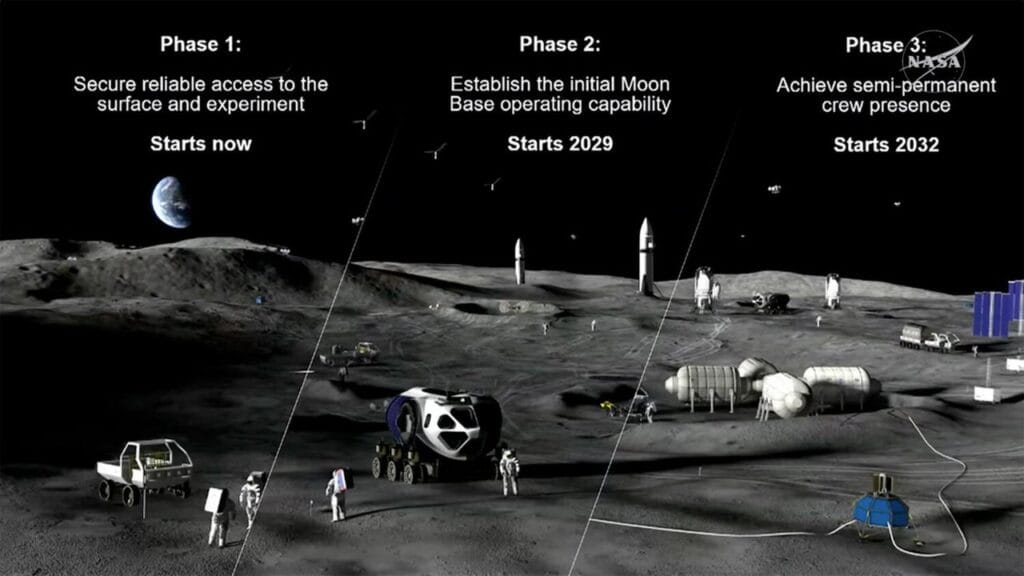
NASA is preparing to write a new chapter in human history, unveiling advanced details of its ambitious plan to establish a permanent presence on the lunar surface. The NASA moon base plan focuses exclusively on the lunar South Pole—a region never explored by previous human missions—now considered the most valuable “real estate” in our solar system due to the presence of water ice in its permanently shadowed craters.
Why the Lunar South Pole?
Unlike the Apollo missions that landed in flat, equatorial regions, the South Pole presents significant technical challenges and rugged terrain. However, the reward justifies the risk. Scientists believe the ice trapped in this region can be harvested and converted into drinking water, breathable oxygen, and most importantly, liquid hydrogen fuel. This “lunar propellant” is the key to turning the Moon into a refueling station for deeper space travel, specifically toward Mars.
The Technology of Lunar Construction
NASA’s goal isn’t just to send astronauts for short stays; it is to build a sustainable infrastructure. This includes advanced solar power systems, high-speed communication arrays, and radiation-shielded habitats. The agency is collaborating with international partners and private companies like SpaceX and Blue Origin to develop the heavy-lift landers required to transport the massive equipment needed for this lunar outpost.
To understand the gravity of this plan, one must look at the “New Space Race.” This is no longer just about scientific curiosity; it is a strategic and technological competition. In the 1960s, the goal was to prove ideological superiority. Today, the goal is economic sustainability and resource control.
This plan falls under the Artemis program, which aims to return Americans to the Moon for the first time since 1972. The U.S. recognizes that the next superpower will be the one that controls lunar resources first. With China and Russia pursuing similar lunar ambitions, the NASA moon base plan is a matter of national security and American technological dominance. Winning this race means controlling the jumping-off point for the colonization of Mars.
Building a base on the Moon is not just a scientific dream; it is a necessity for the future of human exploration. We are witnessing the moments that will define the 21st century and beyond. At US New Todays, we will provide real-time updates on the technical and political developments of this massive undertaking.